The Confrontation Between Husband and Lover
Die, My LoveThe Confrontation Between Husband and Lover is the novel's central turning point, the scene in which the Narrator's two men — her husband and her lover, the Radiologist — finally meet, not as jealous rivals but as negotiators settling the terms of her life. It is the moment the affair dies, the marriage dissolves, and the Narrator is handed from one man to the other like property, a transaction she watches with trembling passivity. The scene gathers every strand of the book's obsession with power, possession, and the animality of human bonds into a single, rain-soaked encounter in an open field, and it ends with the couple's last shared laugh before their final separation.
The Arrival at the Radiologist's House
The scene begins with the Narrator driving alone to the Radiologist's house, having just fled her son's second birthday party in a convertible, shouting that she is giving their son to her husband as a present. She finds the house empty except for the Radiologist's disabled daughter, whom she calls "his princess," visible in the window. There is no trace of the Radiologist or his wife, and the Narrator wonders whether they have abandoned their special daughter. She searches every room — the bed they sleep in, their bathroom, his toothbrush, everything he looks at from the moment he wakes — before collapsing into an embroidered armchair in the living room. Upstairs the daughter moans; downstairs a grandfather clock ticks. She falls asleep and dreams of the sweet, hollow sound of an antler and of him on his back, his hair stuck to her skin, until she wakes to giggles: the Radiologist and his wife are coming down the path, their baskets overflowing with mushrooms. The Narrator goes outside to wait for them, and the wife looks at her with horror.
The Kiss and the Arrival of the Husband
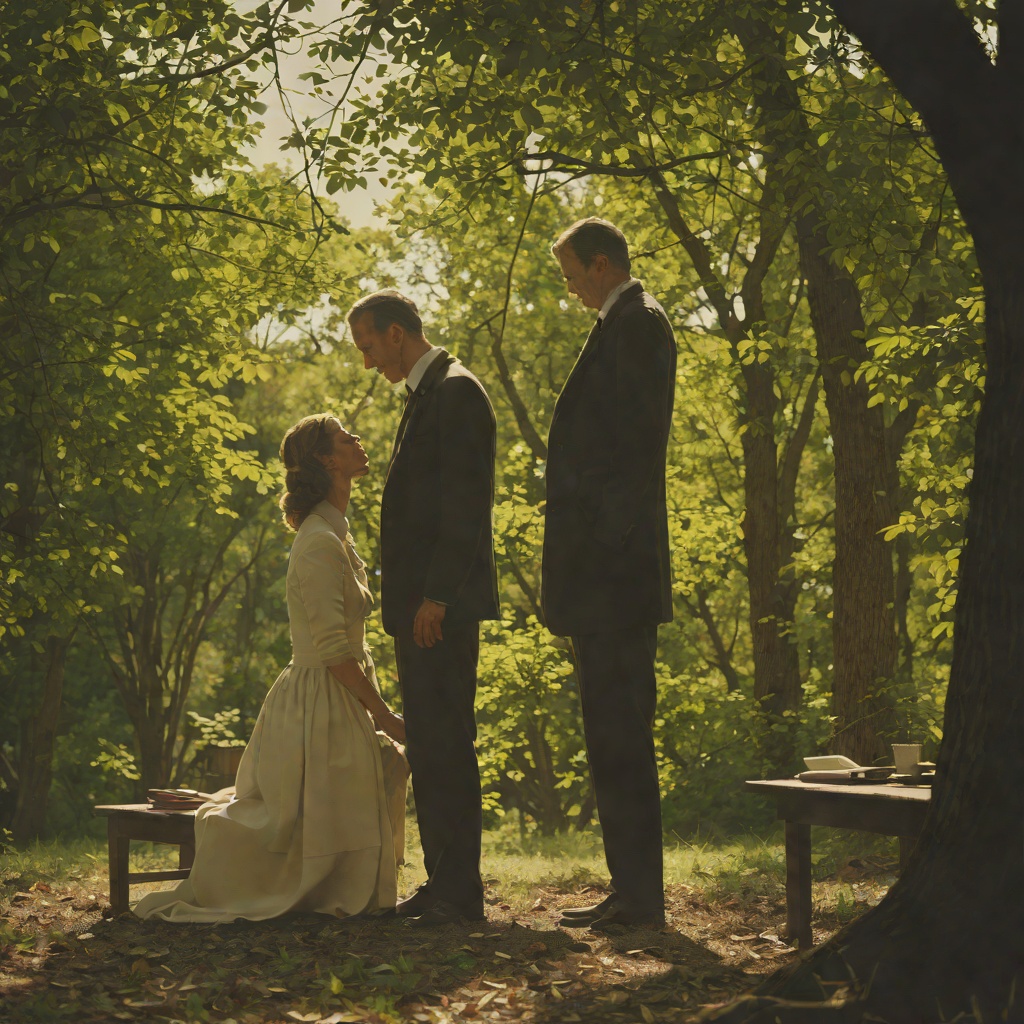
The Radiologist gestures for his wife to go upstairs to their daughter and then takes the Narrator by the arm, walking fifty yards or more away from the house. Face-to-face, they say nothing — "Speaking is so disgusting, after all" — and they kiss. The Narrator sees his face change as he looks at the marks left on her by the glass door she crashed through earlier, and she understands that her tongue on his is a painkiller, that this is the reason he is kissing her. The kiss is powerful, tasting of salty blood, a stopping of death in its tracks. It is at this moment that her husband arrives, riding a motorcycle that is too small for him and makes him look fourteen years old. The Narrator watches her "two bulls, my stallions, my pawns" come together, and no words are needed: the two men understand each other with gestures alone and walk off together into the open fields, stopping where she cannot hear them.
The Negotiation Between the Two Men
The Narrator watches the shadow cast by their bodies, the profiles of the two men facing each other. The Radiologist's wife and daughter appear at the window, one paler than the other. She watches them squaring up for a duel, but the tension dissipates and it becomes like two long-lost brothers catching up, reminiscing about their childhood in the family home, discussing how to settle their dead parents' debts. The sun begins to set over their heads, the gentle light of dusk tinting their bodies, and a soft, steady rain falls on them. As they talk, the Narrator feels her life come and go. She does not know what is being said, only that they are no longer raising their voices. Something about the way they step to the side, the way they nod their heads, tells her they have understood each other. One of them yawns; the other laughs. They have reached an agreement. The "Siamese twins" part, and one of them comes toward her.
The Choice and the Drive into the Woods
The Narrator trembles, wondering who will be her "black-market buyer," what will become of her life, in which home she will live, what they will call her. The man who approaches coughs, and she knows it is her husband, "the most loyal of the two." They walk to the open-top car in silence, a silence more complete than all those that came before it. As they drive home in the rain, she notices a row of cypresses and asks if they are new; he says they have always been there. He does not stop at the front door, but she can tell the party is over because a few blue balloons are drifting over the garden. She asks if the baby is asleep inside, and he replies that he is not a baby anymore — but what she understands is, "he's not your baby any more." They drive into the woods, the wheels leaving tracks in the earth, and the stag does not appear; she is there instead.
The Revelation and the Final Laughter
The husband turns off the engine and relaxes, letting out a breath he has been holding for too long. He asks, "So what do you want to do?" — a question she had not expected. She had thought the outcome would be positive or negative, that he would tell her how much time she had left, in weeks, in days, that he would cry. Instead he asks a question. She cannot say a word. He tells her, "I won't be able to forget," and for the first time he is serious. Then he lights a cigarette and says that the Radiologist and his wife are expecting a child — two, actually, "two tiny twins." Despite trying to stay serious, they cannot help but laugh, at the sound of the words "two tiny twins" perhaps. He asks, "And what if we have one? Another child?" which gives him a coughing fit, and then they are in hysterics again. The two of them sit laughing together for the very last time like a happily married couple. She gets out of the car without opening the door — the convertible being a very practical model for break-ups — and he watches her disappear into the undergrowth.
Aftermath and Mourning
At first the Narrator feels nothing but pain, the kind of pain a person does not share, not even with herself. She is in mourning for a long time, but there comes a moment when, like the widow who unlocks her front door for the first time, who eats dinner in silence for the first time, who gets into bed alone for the first time, she feels a sadness that is exhilarating, wild. The confrontation thus completes the novel's central transaction: the two men, once rivals, become brothers in agreement, and the Narrator is left to mourn the end of both her affair and her marriage, only to discover in that mourning a strange, liberating wildness.